The Invisible Gap Between Traffic and Revenue
You published 47 blog posts this year. Traffic is steady. Engagement looks good.
But here’s the question nobody’s asking: How many of those posts actually booked you a discovery call?
If you’re like most consultants I audit, the answer is zero.
The Uncomfortable Truth

Let me guess what your blog looks like.
You’re publishing once or twice a week. Consistently, even. People leave nice comments. Your analytics show 500 to 3,000 monthly visitors. You’ve got traffic. You’ve got engagement.
But your calendar? Empty.
Here’s the disconnect: You know your blog should be working. You’ve heard other consultants say content marketing transformed their business. You’ve read the case studies. You’ve followed the advice.
And yet. Nothing.
So you start drawing dangerous conclusions. Maybe I’m not a good writer. Maybe blogging doesn’t work anymore. Maybe I just need more traffic.
All wrong.
Last month I audited a consultant’s blog. 83 posts. Beautiful writing. 12,000 monthly views. Zero discovery calls in six months. The problem? Not a single post mentioned what they actually sold.
Your blog isn’t broken. It’s just not wired to convert. Here’s what that means.
The 3 Conversion Killers
Conversion Killer #1: No Clear Offer Connection
Your posts educate, but they never bridge to what you sell.
You write about “10 Leadership Principles” but never mention your coaching program. You explain “How to Build a Content Strategy” but don’t link to your strategy sessions. You share frameworks, models, and insights—all valuable—but none of it points anywhere.
Educational content attracts learners. Strategic content attracts buyers.
Compare two post endings:
Weak: “What leadership principle resonates with you? Comment below.”
Strong: “If you’re struggling to implement these principles alone, my 90-day Leadership Intensive helps executives go from theory to results. Details here.”
The gap is obvious once you see it. Readers learn from you, then hire someone else—because that person made the bridge clear.
Conversion Killer #2: Weak or Missing CTAs
Your calls-to-action are invisible to buyers.
“Learn more.” Learn more about what? “Contact me.” For what purpose? “Let’s connect!” Why should they? “What do you think?” That’s not a CTA—it’s engagement bait.
Effective CTAs name the specific offer, explain what the buyer gets, and make the next step obvious.
Invisible: “Interested in working together? Reach out!”
Visible: “If free discovery calls are draining your time, book a paid 90-minute Strategy Intensive instead. You’ll get a clear action plan, and prospects will show up prepared.”
One invites action. The other hopes for it.
Conversion Killer #3: Random Topics with No Strategic Sequence
Your topics are chosen randomly, with no buyer journey.
Look at your last five posts. Odds are they look something like this: “How to Write Better Emails.” “The Future of AI in Business.” “My Morning Routine.” “Why Most Strategies Fail.” “Book Review: Atomic Habits.”
No connection between them. No journey from curious browser to ready buyer. Posts don’t reinforce each other. No topical authority being built.
A reader could consume ten of your posts and never move closer to understanding what you sell, who it’s for, or why they need it now.
Why This Happens (And Why Past Fixes Haven’t Worked)
You weren’t taught this. Nobody was.
Every blog guru says the same thing: “Provide value.” “Give away your best stuff for free.” “Build authority by sharing your expertise.”
This advice isn’t wrong. It’s incomplete.
Value alone doesn’t convert. Authority alone doesn’t book calls. You need value plus strategic architecture.
And here’s the frustrating part: you’ve probably tried to fix this before.
Content calendars. Pillar-post strategies. Maybe a course on SEO or a $2,000 content strategist. Still nothing.
That’s not because you’re bad at execution. It’s because most content advice is built for traffic, not revenue. More eyeballs. More followers. More “engagement.” None of it maps back to your actual offers.
The missing piece isn’t more tactics. It’s architecture.
Every post needs a conversion job. Every topic should support a specific offer. Every CTA should move someone one step closer to buying.
You’ve been doing what you were told. Publishing consistently. Sharing insights. Being helpful. The problem isn’t you. It’s the system you were following.
The Fix
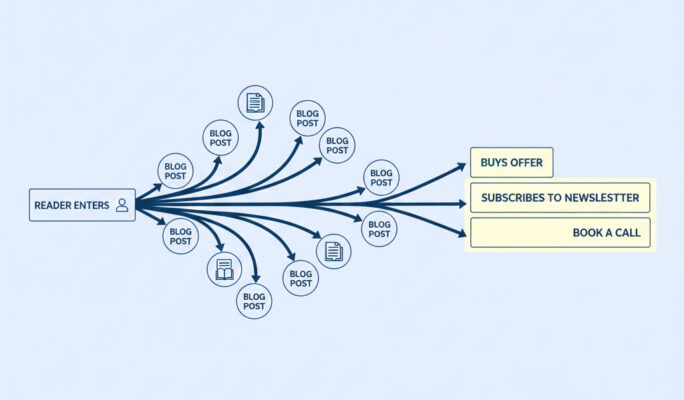
The fix isn’t more content. It’s mapping the content you write to the offers you sell.
Every post on your blog should have a job—a specific offer it points to, a specific stage of the buyer journey it serves. When you map your content this way, you stop publishing “thought leadership” and start publishing posts that book calls.
What this looks like in practice: Post A targets problem-aware readers and leads to your mini offer. Post B targets solution-aware readers and leads to your main offer. Posts link to each other, building topical authority. Every CTA names a specific next step.
You can build this map yourself. Or you can have it done for you in five days.
My Blog → Offer Map service gives you the complete architecture: which posts to write, which offers they should sell, and what order to publish them. $197–$347, delivered in five days. If you follow the map and get zero results in 90 days, full refund.
Your blog isn’t broken. It just needs a destination. The map gives it one.
What’s Next
Ready to fix this? See how the Blog → Offer Map works and choose your plan: netlinke.net/blog-offer-map
Not ready yet? Keep reading. Next week I’ll break down the exact content-to-offer architecture that turns random posts into a conversion system.