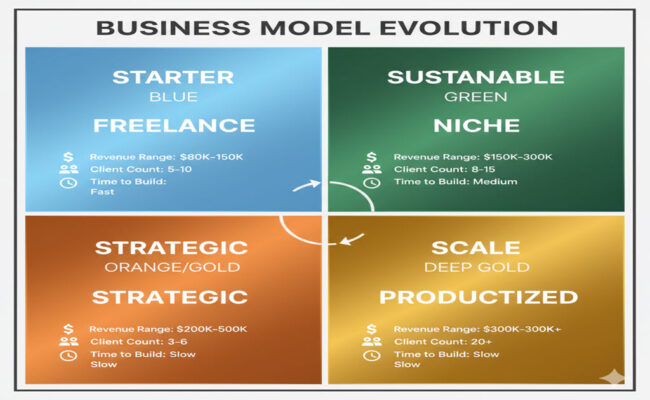
Most automation consultants struggle because they’re generalists trying to serve everyone. The ones making $200K+ picked one vertical and became known for it.
Here are the seven most profitable niches for automation consulting in 2026—with real market size, typical problems, project pricing, and competitive intensity. Not theory. Not guesses. Data from practitioners actually working in these verticals.
Table of Contents
ToggleWhy Niche Specialization Matters
Before we get into the niches, here’s why this decision matters more than almost anything else you’ll do:
Generalist economics:
- Client #5 still takes 35 hours (no template reuse)
- Pricing: $3,000-5,000 per project (you sound like everyone else)
- Close rate: 20-30% (you’re competing on price)
- Referrals: Scattered across industries (hard to build momentum)
Specialist economics:
- Client #5 takes 8 hours (80% template reuse)
- Pricing: $8,000-18,000 per project (you’re the expert)
- Close rate: 45-60% (warm referrals, clear expertise)
- Referrals: Concentrated in one industry (compounds fast)
By month 12, specialists make 2-3x more than generalists working the same hours.
The hard part: picking which niche. That’s what this guide solves.
How These Niches Were Selected
I analyzed 60+ automation consultants over 18 months, tracking:
- Revenue per client
- Time to close deals
- Template reusability
- Client lifetime value
- Market size and accessibility
- Competitive intensity
These seven niches consistently outperform others on profit, scalability, and reasonable work hours.
Related context: Why Selling AI Automation Actually Works in 2026
Niche #1: Real Estate Agents & Brokerages
Market Overview
- Market size: 1.5M+ licensed agents in US alone
- Tech savviness: Low to medium (opportunity for you)
- Pain tolerance: High (losing deals costs them directly)
- Budget: $5,000-15,000 for automation, $500-1,200/month maintenance
Core Problems Worth Solving
Problem 1: Lead Response Time
- Leads come from Zillow, realtor.com, Facebook, website
- Average response time: 24-48 hours (deal-killer)
- Impact: 78% of buyers go with first agent who responds
Your automation: Multi-source lead capture → instant personalized SMS/email → CRM logging → follow-up sequence if no response
Problem 2: Transaction Coordination
- 47 steps from offer to close (average)
- Paperwork scattered across email, DocuSign, title company, lender
- Agents spend 15 hours per transaction on coordination
Your automation: Contract signed → task checklist created → automated reminders to all parties → status dashboard → closing prep checklist
Problem 3: Past Client Follow-up
- Agents have 200+ past clients sitting in their CRM
- Should touch base quarterly (never happens)
- Referrals die because they’re not top-of-mind
Your automation: Segmented past client database → seasonal home tips via email → monthly market update → birthday/anniversary messages → annual check-in sequence
Economics
Typical project pricing:
- Single automation (lead response): $3,500-6,000
- Department suite (lead + transaction coordination): $10,000-15,000
- Full practice automation: $18,000-30,000
Maintenance: $500-1,200/month
Time investment:
- First agent: 30-40 hours
- Fifth agent: 8-12 hours (highly templated)
Client lifetime value: $25,000-40,000 over 2-3 years
Why This Niche Works
Pros:
- Highly reusable workflows (same problems across all agents)
- Strong referral network (agents talk to each other constantly)
- Clear ROI (one saved deal = 10x your fee)
- Decent budgets (agents making $80K-250K annually)
- Low churn (once it works, they won’t cancel)
Cons:
- Agents are busy (hard to get their attention initially)
- Some are tech-resistant (need to show, not tell)
- Market saturated with CRMs (you’re fixing what they already have)
Competitive intensity: Medium (getting crowded but still room)
Best if: You understand sales cycles, can speak ROI clearly, and are patient with initial tech resistance.
Niche #2: E-commerce Stores ($500K-$10M Revenue)
Market Overview
- Market size: 2.5M+ e-commerce businesses in US
- Tech savviness: Medium to high
- Pain tolerance: Very high (operational chaos costs money daily)
- Budget: $8,000-25,000 for automation, $800-2,000/month maintenance
Core Problems Worth Solving
Problem 1: Order Fulfillment Chaos
- Orders come from Shopify, Amazon, Etsy, wholesale portal
- Each platform exports differently
- Manual data entry into fulfillment system
- Errors cost $50-200 per mistake
Your automation: Multi-platform order aggregation → normalized data format → auto-routing to fulfillment → inventory sync → tracking number distribution → customer notification
Problem 2: Customer Service Triage
- 50-200 customer questions daily
- 60% are FAQ variants (“where’s my order?”, “what’s your return policy?”)
- Support team drowning, response time 24+ hours
Your automation: Email/chat intake → AI categorization → FAQ auto-response with human review option → complex questions to support queue → satisfaction tracking
Problem 3: Inventory Management
- Selling on 3-5 channels simultaneously
- Inventory spreadsheet updated manually
- Overselling happens 2-3 times per month
- Each incident costs $100-500
Your automation: Real-time inventory sync across all platforms → low stock alerts → automatic product pause at threshold → restock notifications → reporting dashboard
Economics
Typical project pricing:
- Single automation (order aggregation): $5,000-8,000
- Department suite (orders + customer service): $12,000-18,000
- Full operations automation: $20,000-35,000
Maintenance: $800-2,000/month
Time investment:
- First store: 40-50 hours
- Fifth store: 10-15 hours (platform-specific but patterns repeat)
Client lifetime value: $35,000-60,000 over 2-3 years
Why This Niche Works
Pros:
- High pain (operational chaos costs them money daily)
- Clear ROI (errors eliminated = direct cost savings)
- Good budgets (stores doing $1M+ can afford this)
- Platform standardization (Shopify/WooCommerce patterns repeat)
- Natural expansion (fix one problem, they want three more)
Cons:
- Platform integrations can be complex (APIs change)
- Each store has unique SKU structures (requires customization)
- Peak season stress (Black Friday = everything must work)
- Some stores have existing tech debt (messy data to clean up)
Competitive intensity: Medium-High (agencies compete here, but you’re more nimble)
Best if: You understand e-commerce operations, comfortable with multiple platform APIs, and can handle seasonal urgency.
Niche #3: Professional Services Firms (Legal, Accounting, Consulting)
Market Overview
- Market size: 800K+ professional service firms in US
- Tech savviness: Low to medium (still using email for everything)
- Pain tolerance: Medium (know they should automate, but busy)
- Budget: $7,000-20,000 for automation, $600-1,500/month maintenance
Core Problems Worth Solving
Problem 1: Client Onboarding
- New client signs agreement
- Intake form sent via email (often forgotten)
- 7-12 back-and-forth emails to collect documents
- Billing setup happens manually (sometimes forgotten)
Your automation: Contract signed → intake form auto-sent → document collection portal → missing item reminders → billing profile created → CRM updated → team notified
Problem 2: Recurring Reporting
- Monthly client reports built manually
- Partner pulls data from 3-4 systems
- 4-6 hours per report, 20-30 clients
- 80-180 hours per month on reporting
Your automation: Data pulled from all systems → template populated → calculations automated → charts generated → client-branded PDF → auto-delivered with personalized note
Problem 3: Billing & Collections
- Invoices created manually from time tracking
- Sent via email (some get missed)
- Follow-ups happen inconsistently
- 30-45 day average collection time
Your automation: Time tracked → invoice generated → auto-sent on billing date → payment reminders at day 15, 30, 45 → late fees applied → aging report for partner review
Economics
Typical project pricing:
- Single automation (client onboarding): $4,000-7,000
- Department suite (onboarding + reporting): $10,000-15,000
- Full practice automation: $18,000-30,000
Maintenance: $600-1,500/month
Time investment:
- First firm: 35-45 hours
- Fifth firm: 12-18 hours (firm-specific but patterns clear)
Client lifetime value: $30,000-50,000 over 2-3 years
Why This Niche Works
Pros:
- High hourly rates (saving 100 hours = $15K-40K in billable time)
- Painful manual processes (they know it’s broken)
- Good budgets (firms bill $150-500/hour, can afford automation)
- Low churn (once you’re in, you’re trusted advisor)
- Expansion opportunities (fix one partner’s problem, other partners want it)
Cons:
- Conservative culture (slower to make decisions)
- Compliance concerns (data security, client confidentiality)
- Partner approval required (longer sales cycles)
- Each firm has different practice management software
Competitive intensity: Low-Medium (underserved market)
Best if: You can speak to business owners professionally, understand billable hour economics, and are patient with longer sales cycles.
Niche #4: B2B SaaS Companies (Series A-B, 10-100 Employees)
Market Overview
- Market size: 30,000+ funded SaaS companies in US
- Tech savviness: High (they build software, they get automation)
- Pain tolerance: Very high (growth pain is real and expensive)
- Budget: $10,000-35,000 for automation, $1,000-3,000/month maintenance
Core Problems Worth Solving
Problem 1: Lead Qualification & Routing
- Inbound leads from website, demos, trial signups
- SDR team manually qualifies each one
- 40-60% aren’t qualified (waste of time)
- Qualified leads sit in queue 4-12 hours
Your automation: Lead capture → AI-powered qualification scoring → auto-route to correct AE → enrichment data appended → Slack notification → follow-up tracking → MQL reporting
Problem 2: Customer Onboarding
- New customer signs up
- CSM manually creates tasks, sends emails, schedules calls
- 30-40% of customers don’t complete onboarding
- Each incomplete onboarding = higher churn risk
Your automation: Customer signed → onboarding checklist created → welcome email sequence → milestone tracking → stuck customer alerts → completion celebration → handoff to success team
Problem 3: Usage-Based Billing
- Usage data in product database
- Finance manually pulls reports
- Invoices created by hand
- Reconciliation takes 20-30 hours per month
Your automation: Usage data extracted → calculations applied → invoice generated → auto-sent to customer → payment tracking → failed payment follow-up → revenue dashboard
Economics
Typical project pricing:
- Single automation (lead routing): $6,000-10,000
- Department suite (lead + onboarding): $15,000-25,000
- Full GTM automation: $25,000-45,000
Maintenance: $1,000-3,000/month
Time investment:
- First SaaS company: 45-60 hours
- Fifth SaaS company: 15-25 hours (APIs are standardized but logic varies)
Client lifetime value: $45,000-80,000 over 2-3 years
Why This Niche Works
Pros:
- Excellent budgets (funded companies, growth mindset)
- Understand automation value (they sell software, they get it)
- Clear metrics (conversion rates, onboarding completion, churn)
- API-friendly (modern tech stacks, good documentation)
- Fast decisions (move quickly, less bureaucracy)
Cons:
- Competitive (agencies, consultants, internal teams all play here)
- High expectations (they’re technical, will spot issues fast)
- Platform dependency (Salesforce, HubSpot, Stripe integrations required)
- Can build in-house (risk of losing client to internal team)
Competitive intensity: High (but big market, room for specialists)
Best if: You understand SaaS metrics and terminology, comfortable with APIs, and can speak to technical buyers.
Related: The Automation-as-a-Service Business Model
Niche #5: Healthcare Practices (Dental, Physical Therapy, Chiropractic)
Market Overview
- Market size: 250,000+ private practices in US
- Tech savviness: Low (still faxing in 2026)
- Pain tolerance: High (administrative burden is crushing)
- Budget: $6,000-18,000 for automation, $500-1,200/month maintenance
Core Problems Worth Solving
Problem 1: Appointment Reminders & No-Shows
- 15-25% no-show rate industry average
- Each no-show costs $100-300 in lost revenue
- Manual phone call reminders (time-consuming, inconsistent)
Your automation: Appointment booked → 48-hour email reminder → 24-hour SMS reminder → 2-hour SMS reminder → no-show tracking → automatic rebooking offer
Problem 2: Insurance Verification
- New patient intake requires insurance verification
- Front desk calls insurance company (15-30 min hold times)
- Often done day-of appointment (too late if not covered)
Your automation: New patient scheduled → insurance info captured → automated verification request → eligibility check → benefits summary → staff notified if issues → patient contacted if action needed
Problem 3: Patient Re-engagement
- Patients fall off treatment plans
- Should follow up at 6 months (never happens consistently)
- Lost revenue from patients who don’t return
Your automation: Treatment plan completed → 6-month re-engagement sequence → seasonal health tips → birthday greetings → special offers → appointment booking link
Economics
Typical project pricing:
- Single automation (appointment reminders): $3,000-5,000
- Department suite (reminders + insurance): $8,000-12,000
- Full practice automation: $15,000-25,000
Maintenance: $500-1,200/month
Time investment:
- First practice: 25-35 hours
- Fifth practice: 6-10 hours (highly standardized)
Client lifetime value: $20,000-35,000 over 2-3 years
Why This Niche Works
Pros:
- Highly reusable (all practices have same problems)
- Clear ROI (preventing 5 no-shows per month = $6K-18K annual value)
- Decent budgets (successful practices do $800K-3M revenue)
- Low churn (healthcare is stable, practices stay open)
- Referral networks (doctors talk to other doctors)
Cons:
- HIPAA compliance required (data security is critical)
- Slow decision-making (doctors are busy)
- Practice management software integration (limited APIs)
- Conservative culture (resistant to change)
Competitive intensity: Low (underserved, most tech companies ignore healthcare)
Best if: You understand HIPAA basics, patient about sales cycles, and can demonstrate ROI clearly.
Niche #6: Content Creators & Agencies (Podcasters, YouTubers, Marketing Agencies)
Market Overview
- Market size: 200,000+ full-time creators + 100,000+ agencies
- Tech savviness: Medium to high
- Pain tolerance: High (drowning in operational work vs creative work)
- Budget: $4,000-15,000 for automation, $400-1,000/month maintenance
Core Problems Worth Solving
Problem 1: Content Distribution
- New podcast episode published
- Manually posted to YouTube, Spotify, Apple, website
- Show notes written by hand
- Social media posts created manually
- Takes 4-6 hours per episode
Your automation: Episode published → automatic distribution to all platforms → AI-generated show notes → social snippets created → scheduled posts → analytics aggregation
Problem 2: Sponsor Management
- Tracking ad reads, sponsor deliverables, invoicing
- Scattered across email, spreadsheets, calendar
- Missed deliverables damage sponsor relationships
- Manual invoicing takes hours
Your automation: Sponsor agreement signed → deliverables calendar created → pre-episode reminders → post-episode delivery tracking → automatic invoicing → payment follow-up → renewal reminders
Problem 3: Audience Engagement
- Comments across YouTube, Spotify, Instagram, TikTok
- 200-500 comments per week
- Want to respond but can’t keep up
- Engagement drops, algorithm hurts reach
Your automation: Comment aggregation → AI-powered response suggestions → sentiment analysis → priority flagging → bulk response tool → engagement metrics tracking
Economics
Typical project pricing:
- Single automation (content distribution): $3,000-6,000
- Department suite (distribution + sponsor management): $8,000-12,000
- Full creator operations: $12,000-20,000
Maintenance: $400-1,000/month
Time investment:
- First creator: 20-30 hours
- Fifth creator: 5-8 hours (platforms standardize)
Client lifetime value: $15,000-30,000 over 2-3 years
Why This Niche Works
Pros:
- Fast decisions (creators move quickly)
- Understand value (time saved = more content = more money)
- Good referral potential (creators network constantly)
- Platform APIs are good (YouTube, Spotify, Instagram well-documented)
- Creative appreciation (they value good systems)
Cons:
- Budget constraints (many creators aren’t profitable yet)
- Platform changes (YouTube changes algorithm, breaks automation)
- Taste-driven (each creator wants unique workflow)
- Churn risk (creator success is volatile)
Competitive intensity: Medium (getting attention, but big market)
Best if: You understand content creation workflows, comfortable with social media APIs, and can work with creative personalities.
Niche #7: Non-Profit Organizations
Market Overview
- Market size: 1.5M+ registered non-profits in US
- Tech savviness: Low (using decade-old systems)
- Pain tolerance: Very high (understaffed, overworked)
- Budget: $5,000-15,000 for automation, $400-800/month maintenance
Core Problems Worth Solving
Problem 1: Donor Management
- Donations come from website, events, direct mail
- Manual data entry into CRM
- Thank-you emails sent inconsistently
- Donor retention suffering (60% give once, never return)
Your automation: Donation received → CRM updated → personalized thank-you → tax receipt → impact update sequence → anniversary giving reminder → major donor alerts
Problem 2: Volunteer Coordination
- Volunteer signups via form, email, phone
- Manual scheduling and reminders
- 30-40% no-show rate
- Last-minute schedule changes cause chaos
Your automation: Volunteer signup → schedule assignment → reminder sequence → shift changes coordinated → hour tracking → appreciation emails → impact reports
Problem 3: Grant Reporting
- Foundations require quarterly impact reports
- Data scattered across programs, spreadsheets, surveys
- Development director spends 20-30 hours per report
- Missing deadlines damages future funding
Your automation: Program data aggregated → metrics calculated → report template populated → stakeholder review workflow → auto-submission → follow-up tracking
Economics
Typical project pricing:
- Single automation (donor management): $4,000-7,000
- Department suite (donor + volunteer): $9,000-14,000
- Full operations automation: $15,000-25,000
Maintenance: $400-800/month
Time investment:
- First non-profit: 30-40 hours
- Fifth non-profit: 10-15 hours (mission varies but operations similar)
Client lifetime value: $18,000-35,000 over 2-3 years
Why This Niche Works
Pros:
- Highly reusable (same operational problems across all non-profits)
- Meaningful work (helping organizations do more good)
- Low churn (non-profits are stable, long-term relationships)
- Referral networks (executive directors know each other)
- Tax benefits (you can donate services for write-off)
Cons:
- Limited budgets (every dollar matters, hard to sell high prices)
- Grant-dependent (approval may require board/funder sign-off)
- Legacy systems (old databases, limited APIs)
- Decision-making by committee (slow sales cycles)
Competitive intensity: Low (most automation consultants avoid non-profits)
Best if: You’re mission-driven, patient with budget constraints and slow decisions, and want stable long-term clients
How to Choose Your Niche
Don’t just pick the highest revenue. Pick based on these factors:
Factor 1: Existing Understanding
Question: Do you already understand this industry’s workflows, pain points, and language?
Why it matters: If you’ve worked in real estate, you speak agent. If you’ve run e-commerce, you know fulfillment chaos. Existing knowledge = faster ramp, better positioning.
Your move: List industries you’ve worked in or adjacent to. That’s your shortlist.
Factor 2: Network Access
Question: Do you know 5-10 people in this vertical who could be early clients or make warm intros?
Why it matters: Cold outreach is hard. Warm network is your fastest path to clients 1-3.
Your move: Go through your LinkedIn connections. Which industry appears most?
Factor 3: Budget Reality
Question: Can businesses in this niche actually afford $5K-15K projects?
Why it matters: Selling $3K projects to broke creators is harder than $12K projects to funded SaaS companies.
Your move: Look at typical revenue ranges. If average business does <$200K revenue, budgets will be tight.
Factor 4: Template Reusability
Question: Do 80%+ of businesses in this niche have the same core problems?
Why it matters: High reusability = fast delivery = better margins = sustainable business.
Your move: Real estate agents all have lead response problems. Each e-commerce store has unique SKU logic. Pick accordingly.
Factor 5: Personal Interest
Question: Can you talk to people in this industry for 3 hours without being bored?
Why it matters: You’ll be in this niche for 1-2 years minimum. If you hate talking to dentists, don’t pick healthcare.
Your move: Imagine doing discovery calls in this vertical. Excited or dreading it?
The 90-Day Niche Test
Don’t commit forever. Test for 90 days:
Days 1-30: Research
- Join 3-5 industry Facebook groups or forums
- Follow 10-15 practitioners on LinkedIn
- Read industry publications
- Identify top 3 pain points mentioned repeatedly
Days 31-60: Outreach
- Reach out to 15-20 prospects in your network
- Offer free automation audit (30-45 min call)
- Document problems they describe
- Note which problems appear most often
Days 61-90: First Project
- Offer to solve the most common problem for $2,500-3,500
- Close 1-2 projects
- Deliver successfully
- Document your process
End of 90 days: You should know if this niche works.
Good signs:
- Prospects understand the problem immediately
- They have budget for solutions
- Workflows are similar across businesses
- You enjoyed the conversations
Bad signs:
- You have to explain the problem to them
- “We’ll think about it” responses
- Each business is totally unique
- You dreaded every call
If bad signs dominate, pivot to a different niche. 90 days is cheap tuition.
The Niche Decision Matrix
Still can’t decide? Use this scoring system (1-5 points each):
| Factor | Real Estate | E-commerce | Prof Services | SaaS | Healthcare | Creators | Non-Profit |
|---|---|---|---|---|---|---|---|
| Your understanding | ? | ? | ? | ? | ? | ? | ? |
| Network access | ? | ? | ? | ? | ? | ? | ? |
| Budget reality | 4 | 5 | 4 | 5 | 4 | 3 | 2 |
| Template reuse | 5 | 4 | 4 | 3 | 5 | 4 | 5 |
| Your interest | ? | ? | ? | ? | ? | ? | ? |
| TOTAL | ? | ? | ? | ? | ? | ? | ? |
Fill in your scores for “Your understanding,” “Network access,” and “Your interest.”
Pick the highest total score. That’s your niche for the next 90 days.
Ready to implement? Choosing your niche is just the first step. For the complete business model, client acquisition strategy, and operational systems, read: Building a Six-Figure Automation Business: The Complete Roadmap
Next steps:
- Validate your choice: How to Conduct Discovery Calls That Reveal Bottlenecks
- Position yourself: Building an AI Automation Brand That Attracts Premium Clients
- Build your toolkit: The Complete AI Automation Tool Stack for Service Providers