Most people think AI will replace their jobs. The smarter ones are selling it instead. Here’s why offering automation to business owners is one of the few opportunities in 2026 that’s still early enough to matter—and what separates people making money from those just talking about it.
You’re Not Selling AI. You’re Selling Relief.
Everyone’s still talking about AI like it’s revolutionary.
But here’s what’s actually happening in 2026: the freelancers making money aren’t the ones playing with the latest models. They’re the ones who stopped asking “how can I use AI?” and started asking “who’s drowning in manual work right now?”
This is the shift that matters. AI automation isn’t about shiny tools. It’s about fixing boring, broken systems that eat up someone’s Tuesday afternoon every week.
The gap between what AI can do and what business owners actually need done—that’s where the opportunity sits. Not in the tools. In the translation.
If you can speak both languages, you’re not competing with other freelancers. You’re competing with the client doing it manually forever.
Why Business Owners Actually Want This
Most business owners aren’t anti-AI. They’re exhausted.
They’ve tried three different tools that promised “hands-free growth” and ended up with another dashboard collecting dust. Another Slack notification they ignore. Another thing their team resents.
What they want isn’t more automation. It’s relief.
Fewer browser tabs open at 11pm. Fewer mistakes in the CRM that cost them deals. Fewer leads falling through because someone forgot to follow up on Friday afternoon.
Your job isn’t to sell another app. It’s to fix the specific process breaking their day.
The invoice that never gets sent on time. The customer question sitting in email for 48 hours. The report they manually copy-paste every Monday at 9am because “that’s just how we do it.”
You don’t need to code. You need to sit down, figure out what’s wasting their time, then make it stop.
That’s the real barrier now: empathy and systems thinking, not technical skill.
The tradeoff nobody mentions: You can’t template everything. Each client’s chaos is unique. Expect to spend more time in discovery than you budgeted. That’s the cost of doing this right.
The Market Window Is Closing Faster Than You Think
Here’s what changed: the experimentation phase is over.
In 2024, businesses were asking “does AI work?” In 2026, they’re asking “who can make it work without breaking what we already have?”
This is what happened with web design around 2012. It went from “nice to have” to “obviously necessary” in about 18 months. You’re watching the same thing happen with automation right now.
If you can connect a few tools—ChatGPT, Make.com, Google Sheets—and you understand how real people actually use them at work (not how the tutorial says they should), you can charge for clarity instead of complexity.
The boring truth: you’re not selling AI. You’re selling the ability to explain what it does in plain language and set it up so it doesn’t break next Tuesday.
What this means: The window is open now, but it won’t stay open long. In 12 months, this will be commoditized. Right now, you’re just early enough to charge a premium for knowing what you’re doing.
The people who wait until it’s “proven” will be competing on price with tools and templates.
The Three Market Forces Creating This Opportunity
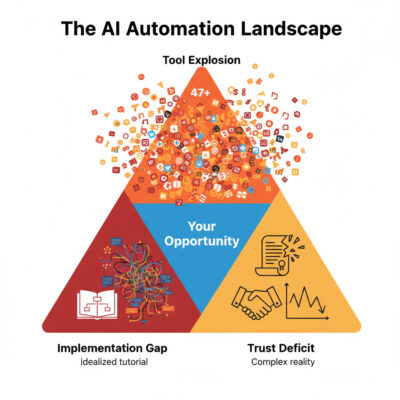
Force #1: The Tool Explosion
There are now 47 different ways to automate the same workflow. Business owners don’t need more options—they need someone to tell them which one actually works for their specific situation.
Make.com, Zapier, n8n, Power Automate, IFTTT, custom APIs, ChatGPT plugins, Claude workflows, Gemini integrations. Every week there’s a new tool promising to be “the easiest way to automate.”
This abundance creates paralysis. Business owners know they should automate. They just don’t know where to start or which tools to trust.
That’s your opening. You’re not selling tools—you’re selling confident navigation through the tool jungle.
Force #2: The Implementation Gap
Most business owners can sign up for Make.com. Very few can actually build a workflow that handles edge cases and doesn’t break when someone enters data in an unexpected format.
The gap between “I watched the tutorial” and “this actually works in my business” is where you get paid.
You’re not selling difficulty. You’re selling reliability. The automation that keeps working on Tuesday morning when they’re in a client meeting and can’t troubleshoot why the lead capture form stopped sending to their CRM.
Force #3: The Trust Deficit
Business owners have been burned by tools that overpromised. They signed up for the “automated marketing funnel” that generated zero leads. They paid for the “AI customer service” that responded to every inquiry with generic nonsense.
They’re skeptical now. And that’s good for you.
Because if you can show up, deliver one small automation that actually works, and demonstrate it saves them real time or prevents real mistakes—you immediately stand out from the 47 “AI experts” on LinkedIn promising transformation in 30 days.
Trust is built through proof, not promises. And right now, most people in this space are still making promises.
Why This Actually Scales (And Most Services Don’t)
Automation isn’t sexy. It’s efficient. That’s what makes it powerful.
You build one workflow that saves a client 10 hours a week. Then you realize their competitor has the same problem. You clone that workflow in an afternoon with minor tweaks.
No new materials. No new inventory. No new creative process. Just reusable systems.
Here’s what that looks like:
- Minimal overhead: You’re mostly paying for tool subscriptions ($50-200/month)
- Repeatable delivery: Second client takes 30% of the time the first one did
- Predictable results: You know it works because you’ve deployed it before
- Scalable profit: Income stops being tied to your hours
I’ve seen this pattern: the first three builds take 40 hours each. The fourth takes four hours. Once you’ve built a lead follow-up system three times, you start seeing the universal patterns underneath the surface chaos.
The catch nobody talks about: Those first three clients are learning experiences where you underprice and over-deliver. That’s the tax you pay for figuring out what actually works. Budget for it.
Most people quit after client two because they’re still losing money. The leverage kicks in at client four.
For the complete economics and scaling roadmap
The Replication Economics
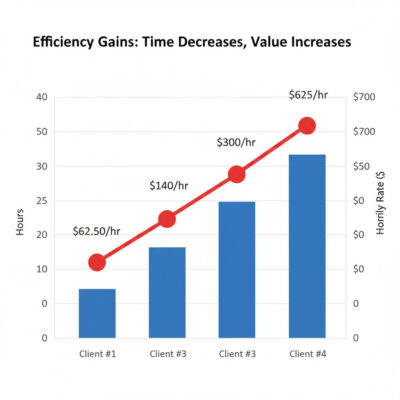
Let’s look at the actual math:
Client #1:
- Time invested: 40 hours
- Revenue: $2,500 (underpriced because you’re learning)
- Effective hourly: $62.50
- Profit after tools: ~$2,300
Client #2:
- Time invested: 25 hours (60% reusable from client #1)
- Revenue: $3,500 (slightly less underpriced)
- Effective hourly: $140
- Profit after tools: ~$3,250
Client #3:
- Time invested: 15 hours (75% reusable)
- Revenue: $4,500 (closer to market rate)
- Effective hourly: $300
- Profit after tools: ~$4,250
Client #4:
- Time invested: 8 hours (85% reusable)
- Revenue: $5,000 (full market rate)
- Effective hourly: $625
- Profit after tools: ~$4,750
By client #4, you’re making $625/hour on work that’s mostly copy-paste with minor customization. That’s the leverage curve.
Compare this to:
- Freelance writing: Every article is custom, no replication
- Web design: Every site is custom, maybe 30% template reuse
- Social media management: Every post is custom, continuous time drain
- Virtual assistance: Paid hourly, no leverage at all
Automation is one of the few service models where your 10th client literally takes less time than your first.
What Business Owners Actually Buy
Business owners don’t buy bots. They buy peace of mind.
They want their inbox to stop feeling like a second job. They want customers to get answered while they’re in meetings. They want their team to stop asking “did anyone follow up with that lead from Tuesday?”
Stop pitching “AI-powered automation workflows” and start describing what goes away when it’s implemented:
- The late invoices that damage client relationships
- The missed leads that go to competitors
- The 10-hour manual report they dread every month
- The customer who churned because no one reached out for 45 days
When you talk about outcomes instead of features, you’re selling relief, not technology.
Here’s what this sounds like in practice:
Bad: “I’ll build you an AI agent that processes customer inquiries using GPT-4 and routes them through Make.com with conditional logic.”
Better: “You know how customer questions sit in your inbox for two days before anyone answers them? I can fix that so they get a response in 10 minutes, even when you’re offline. No more apology emails for slow replies.”
The first one demonstrates technical knowledge. The second one demonstrates you understand their actual problem.
The Four Problems Worth Solving
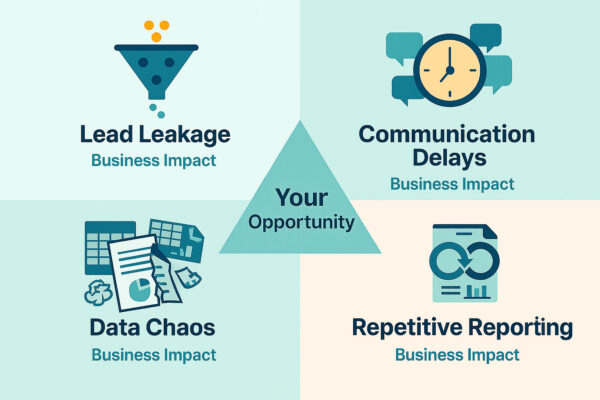
Not every manual process is worth automating. Focus on these four categories where businesses feel real pain:
1. Lead Leakage
- Leads coming in from multiple sources (website, social, referrals)
- No consistent follow-up system
- People fall through cracks regularly
- Business impact: Direct revenue loss (every missed lead is potential revenue)
2. Communication Delays
- Customer questions sitting unanswered for 24-48 hours
- Internal requests getting lost in email
- Team doesn’t know who’s handling what
- Business impact: Customer satisfaction, retention, reputation
3. Data Chaos
- Information scattered across multiple tools
- Manual copy-paste between systems
- No single source of truth
- Business impact: Bad decisions based on incomplete data, wasted time searching
4. Repetitive Reporting
- Same report built manually every week/month
- Takes 2-10 hours of someone’s time
- Error-prone copy-paste work
- Business impact: Opportunity cost (high-value employee doing low-value work)
If you can solve one of these four problems reliably, you have a business.
What won’t work: Trying to sell automation to people who don’t feel pain yet. If their current manual process is “fine,” they won’t pay to fix it. You need clients who are actively frustrated.
The Toolkit: What You Actually Need
You don’t need a PhD. You need to know what’s wasting someone’s time.
Start with one bottleneck. Not five. One.
- Leads not being followed up within 24 hours
- Invoices stuck in email, never making it to accounting
- Data scattered across 12 spreadsheets that no one reconciles
- Customer questions going unanswered for days
Then fix it using off-the-shelf tools.
Standard stack:
- ChatGPT / Claude / Gemini: Text generation and simple decision logic
- Zapier / Make / n8n: Connecting systems that don’t talk to each other
- Airtable / Notion / Google Sheets: Tracking and organizing data
- Slack / Gmail / Stripe: Triggers for automated actions
The tools aren’t the hard part. The hard part is knowing which process to automate first—and which ones to leave alone.
Some things shouldn’t be automated. Customer complaints need human empathy. Refund requests require judgment. Anything involving nuance or emotion breaks automation fast.
If you automate the wrong thing, you create more problems than you solve. I’ve seen companies automate their customer support and spend six months rebuilding trust with customers who felt ignored by a bot.
Start here: Ask your first client to track every recurring task for one week. Screenshot it. Write it down. Then automate the top three by time spent. Ignore everything else until those three are running smoothly.
The Three-Tier Tool Strategy
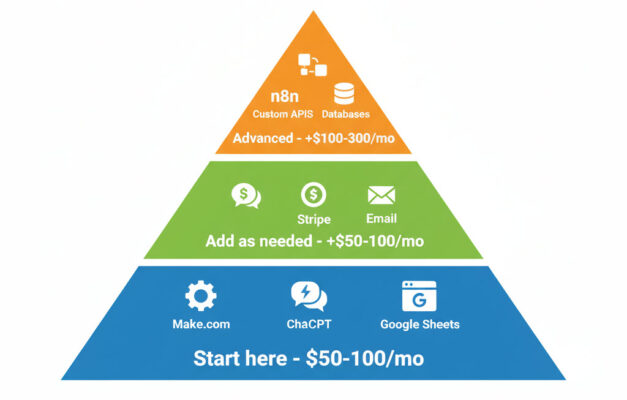
Tier 1: Core Stack (Learn these first)
- Make.com (workflow automation – most powerful)
- ChatGPT API (AI decisions and text)
- Google Sheets or Airtable (data management)
Cost: $50-100/month Time to learn: 2-3 weeks to functional competence Why: Handles 80% of client needs
Tier 2: Expansion Tools (Add as needed)
- Claude API (alternative AI for specific use cases)
- Slack/Discord webhooks (team notifications)
- Stripe/PayPal APIs (payment automation)
- Email platforms (SendGrid, Mailgun)
Cost: +$50-100/month as you add clients Time to learn: 1 week per tool Why: Specific client requirements, not every project
Tier 3: Advanced Capabilities (6+ months in)
- n8n (self-hosted automation for complex workflows)
- Custom API integrations (client-specific systems)
- Database connections (PostgreSQL, MySQL)
- Advanced AI (fine-tuned models, vector databases)
Cost: +$100-300/month Time to learn: 2-4 weeks per capability Why: Premium pricing, competitive differentiation
Most people make the mistake of trying to learn everything in Tier 3 before getting their first client. You only need Tier 1 to start making money.
Standing Out When Everyone’s an “AI Expert”
By mid-2026, every freelancer will have “AI automation” in their LinkedIn headline.
Most won’t last six months. They’ll sell tools, not trust.
The ones who survive will:
- Sound like humans, not SaaS landing pages
- Show actual results with real numbers
- Explain things in plain language their mom would understand
- Admit when something won’t work for a client’s situation
If you want clients who pay well and stick around, build a reputation for honesty. That means sometimes saying “this isn’t a good fit for automation” or “you should fix your process manually first, then we’ll automate it.”
The market is getting noisy fast. What cuts through noise isn’t louder marketing. It’s being the person who tells the truth when everyone else is overselling.
Most “AI consultants” will promise 90% time savings and deliver 15%. If you promise 20% and deliver 25%, you’ll have more referrals than you can handle.
Practical move: Document one client result with real numbers. Not “increased efficiency”—actual hours saved per week, actual revenue protected, actual problems solved with before/after screenshots. That case study is worth more than any promise you’ll make.
The Credibility Stack
Build trust through these five layers (in priority order):
1. One documented result
- Before/after screenshots
- Specific time saved (hours per week)
- Client testimonial (video if possible)
- Why it works: Proof beats promises
2. Clear specialization
- “I help real estate agents” not “I help businesses”
- One industry or one problem type
- Specific tool expertise (Make.com specialist)
- Why it works: Specialists charge more than generalists
3. Plain language explanation
- Can your mom understand what you do?
- No jargon in your pitch
- Simple before/after story
- Why it works: Clarity builds confidence
4. Honest limitations
- “This works for X, not for Y”
- “Here’s what this won’t solve”
- “You need A before we can do B”
- Why it works: Honesty differentiates in a hype-filled market
5. Consistent visibility
- Weekly content showing your thinking
- Answer questions in relevant communities
- Share what you’re learning
- Why it works: Top-of-mind when need arises
You don’t need all five on day one. But by client three, you should have at least #1, #2, and #3.
The Divide That’s Already Happening
Let’s be direct: some freelancers will lose clients to AI. Others will own the AI their clients depend on.
The difference is simple.
One group treats AI like a threat to their hourly rate. The other sells it as infrastructure their clients can’t work without.
If you’re selling manual work—data entry, basic research, simple copywriting—your margins shrink every month. The client will eventually find a tool that does it cheaper, or an AI model that does it free.
If you’re selling automation systems, you’re building something people can’t easily replace. Not because the tools are complicated. Because the value isn’t in the tools—it’s in knowing which tools to use, how to connect them for this specific business, and how to maintain them when something inevitably breaks.
The uncomfortable truth: This transition isn’t optional. The market is moving whether you move with it or not. You either charge for automation or compete with it on price. Those are your options.
Six months from now, “I’ll write your blog posts” is a race to the bottom. “I’ll build the system that helps you create better content faster” is a retained relationship.
The Two Paths Forward

Path A: Compete with AI
- Sell manual execution (writing, data entry, research)
- Race to the bottom on price
- Work more hours for less money
- Eventually replaced by better AI models
Path B: Sell AI as infrastructure
- Position as the automation strategist
- Charge for systems, not hours
- Build recurring revenue through maintenance
- Become more valuable as AI improves (more to automate)
The window to switch from Path A to Path B is about 12-18 months. After that, the market perception solidifies. You’re either “the person who does the work” or “the person who builds the systems.”
Choose now, while you still can.
Who Wins in 2026
The hype is fading. Results are starting to matter.
This is when practical people start winning. Not the ones with the biggest Twitter following or the most LinkedIn thought leadership posts. The ones who can speak both business and automation.
If you can translate “we need to follow up with leads faster” into “here’s a Make.com workflow that sends a personalized message within 5 minutes of form submission,” you’re not just in the game. You’re ahead of most people still arguing about which AI model is best.
The opportunity isn’t in the tools. Zapier and Make.com are commodities. ChatGPT is free. The opportunity is in your ability to translate them into relief for people who are already overwhelmed.
Your next move: Find one business owner who complains about a repetitive task. Offer to automate it for free or cheap. Document what you build with screenshots and time saved. Then do it again for real money.
That’s the entire playbook. Everything else is noise.
Ready to go deeper? This is just the market overview. For the complete business model breakdown, implementation roadmap, and systems that make this sustainable, read: Building a Six-Figure Automation Business: The Complete Roadmap
Next steps:
- Choose your niche: 7 Profitable AI Automation Niches for 2026
- Understand the model: The Automation-as-a-Service Business Model
- Learn the psychology: Psychology of Selling Automation to Traditional Business Owners
- Understand the need: Why AI Automation Will Replace Freelancers Who Don’t Adapt