The Monday Morning That Changed Everything
Imagine walking into your Monday meeting to find half of your team’s routine reports, emails, and scheduling already completed — not by employees, but by intelligent AI systems quietly working overnight.
No complaints, no sick days, no burnout — only precision, consistency, and data-driven execution.
This is not science fiction. It’s the new operational reality for forward-thinking companies that have replaced or augmented human labour with AI workers — digital systems that execute tasks, make informed decisions, and scale output at near-zero marginal cost.
At netlinkE, we’ve seen this transformation unfold across marketing agencies, e-commerce brands, and service-based businesses. Those that move early thrive. Those that delay often find themselves stuck in bloated structures while competitors scale effortlessly with AI-driven operations.
Curious what a complete AI-powered business structure looks like? Explore our AI Worker Blueprint to see how intelligent systems replace repetitive human tasks with scalable automation.
Why Traditional Structures Are Reaching Their Limit
For decades, businesses scaled by adding more people. More sales? Hire more reps. More content? Hire more writers. More clients? Build another department.
But in 2025 and beyond, that model cracks under three pressures:
-
Cost Inflation: Hiring, training, and retaining staff drain cashflow faster than ever.
-
Operational Lag: Human processes are slow and inconsistent compared with algorithmic systems.
-
Talent Scarcity: The best people now want autonomy, not full-time roles — leaving critical gaps in execution.
The result? Companies carry structural inefficiency that kills agility. Every new client or project requires proportional increases in payroll and management overhead.
That’s where the AI workforce paradigm steps in.
What It Means to Have “AI Workers”
An AI worker is not a gadget or a one-off automation. It’s a digital entity that performs repeatable, outcome-driven work.
Examples include:
-
AI writing assistants (e.g., ChatGPT, Claude) that create articles, product descriptions, or emails.
-
Automation platforms (e.g., Zapier, Make) that connect apps, schedule actions, and eliminate manual admin.
-
AI customer-service bots (e.g., Intercom Fin, Heyday) that handle 80% of front-line inquiries.
-
AI data analysts (e.g., Power BI Copilot, ChatGPT Advanced Data Analysis) that generate reports and insights.
-
AI design or media tools (e.g., Midjourney, ElevenLabs) that handle creative production at scale.
These systems don’t replace people — they replace positions. They free humans for strategy, relationship-building, and innovation rather than repetitive execution.
If you’re ready to identify which of your team’s tasks are ideal for automation, start with our Automation Audit Guide — it helps you map which workflows can become AI-powered first.
As netlinkE’s automation frameworks show, when AI workers are deployed correctly, they become the invisible engine of scale: consistent, fast, and infinitely trainable.
The Strategic Framework for Transition
Transitioning from employees to AI workers is not about “firing staff and installing robots.”
It’s a phased transformation across four dimensions: mindset, mapping, migration, and management.
Phase 1 – Mindset Shift: From Labour to Leverage
The first step is psychological. Leaders must stop equating “growth” with “headcount.”
In the AI era, growth equals leverage: the ability to produce more output with the same or fewer inputs.
At netlinkE, we encourage executives to ask:
“If we rebuilt our company today from scratch, how many of these roles would be digital by design?”
Phase 2 – Mapping Current Workflows
List every recurring task your team performs in a typical week. Categorise each as:
-
Creative/strategic (best done by humans)
-
Repetitive/rule-based (ideal for AI automation)
-
Analytical/data-driven (shared between humans and AI)
Tools such as Notion AI or Asana AI can even assist in documenting and categorising this automatically.
Phase 3 – Migration to AI Systems
Replace low-value, high-frequency tasks first.
Examples:
-
Automate client onboarding forms with Typeform + Zapier.
-
Use ChatGPT or Jasper to draft first-round copy before human review.
-
Implement AI scheduling (Reclaim AI, Motion) to manage calendars.
Each successful migration builds internal confidence — and measurable ROI.
Phase 4 – Management & Continuous Training
For a complete breakdown of each phase, including real implementation examples, see our AI Workforce Transition Framework — a step-by-step guide to shifting from manual to intelligent systems.
AI workers must be “trained,” just like people. Feed them better data, refine prompts, and update workflows regularly.
Establish metrics: accuracy, turnaround time, and cost per output.
netlinkE’s clients often assign a human-in-the-loop manager to oversee AI performance, ensuring accountability without micro-management.
Common Pitfalls to Avoid
Even seasoned executives stumble when pivoting to an AI workforce. The main traps include:
-
Over-automation: Replacing human judgment with rigid rules. Keep strategy and empathy human.
-
Tool hopping: Chasing new apps instead of building a stable AI stack.
-
Neglecting data quality: Garbage in, garbage out — poorly structured data ruins AI output.
-
Cultural resistance: Staff fear replacement. Communicate that AI elevates roles rather than erases them.
The key is integration, not imitation. You are not building a robot version of your team; you’re designing a smarter operational organism.
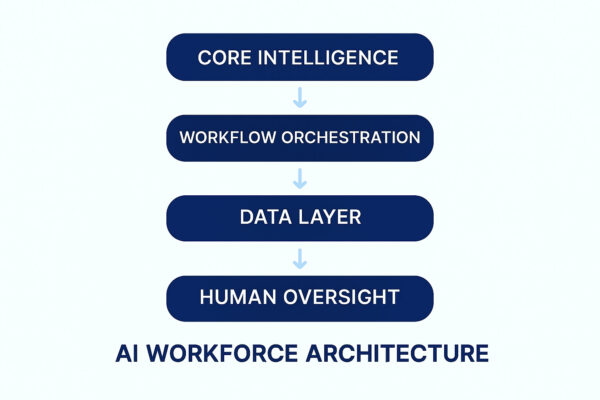
Building Your AI Workforce Architecture

Every modern organisation will, sooner or later, resemble a hybrid human-AI ecosystem.
Here’s a simple blueprint that netlinkE uses to design sustainable automation structures:
1. Core Intelligence Layer
Your AI engines — language models, image generators, predictive algorithms.
They handle creation, analysis, and insight.
2. Workflow Orchestration Layer
Automation hubs like Zapier or n8n coordinate multiple AI agents, ensuring data and actions flow seamlessly between systems.
3. Data Layer
Centralised databases (Airtable, Notion, custom CRMs) feed consistent information to AI workers.
4. Human Oversight Layer
Strategists and managers who supervise, refine prompts, and make high-impact decisions.
The result: a network of AI workers running 24/7, scaling every department without multiplying salaries.
This layered design is detailed in our AI Worker Blueprint, where we show how to stack automation tools, data layers, and human oversight into one seamless ecosystem.
Measuring the ROI of AI Workers
Executives often ask, “How do we prove this isn’t just hype?”
The answer lies in clear metrics:
| KPI | Human Model | AI-Integrated Model | Typical Improvement |
|---|---|---|---|
| Content production cost | $0.20–$0.40 / word | $0.03–$0.05 / word | 80–90 % reduction |
| Lead-response time | 3–6 hours | Instant (AI chatbot) | 100 × faster |
| Report generation | 1 analyst / day | AI data agent / minutes | 95 % time saved |
| Customer satisfaction | 7.5 / 10 | 8.8 / 10 | +17 % increase |
You can view detailed results from real businesses that implemented these systems in our AI Workforce Case Studies — including ROI benchmarks and automation timelines.
These numbers aren’t theoretical. They reflect real-world implementations drawn from netlinkE’s automation audits and client systems.
The Human Side of the Transition
Ironically, the biggest challenge in building an AI workforce isn’t technical — it’s emotional.
People equate job security with relevance. The shift must therefore be led with empathy and transparency.
Communicate clearly:
-
AI isn’t replacing people, it’s replacing processes.
-
Employees can evolve into AI operators or workflow designers.
-
Upskilling should be part of the rollout plan.
To maintain long-term performance, every AI system needs continuous training and refinement. Learn how in our AI Worker Training Systems Guide.
netlinkE’s most successful transformations include internal training sessions that show teams how to collaborate with AI rather than compete against it.
The Future of Work: From Labour to Intelligence
The companies dominating the next decade will share one trait:
They will think in systems, not staffing.
In the same way electricity replaced human muscle in factories, AI will replace mental repetition in offices.
What remains is creativity, vision, and human connection — things no algorithm can replicate.
Those who act now will build organisations that scale infinitely while retaining a human soul.
Those who wait will find themselves out-paced by leaner, smarter competitors whose “employees” never sleep.
Taking the Next Step
If this vision resonates — if you’re ready to explore how AI workers can transform your company’s productivity, margins, and growth — then it’s time to act.
Book a consultation or full automation audit with netlinkE.
Our specialists map your workflows, identify automation opportunities, and design AI systems tailored to your operations.
In most cases, clients see measurable efficiency gains within the first 30 days.
The future workforce isn’t arriving — it’s already here.
The only question is whether you’ll hire it.
Related Posts:
-
To understand the layers that make AI workers function seamlessly, explore our AI Worker Blueprint.
-
We break down the exact 4-phase model in our detailed AI Workforce Transition Framework.
-
Not sure where to start? Run a full Automation Audit to identify which workflows are ready for AI.
-
See how businesses achieved real ROI in our AI Workforce Case Studies.
-
Learn how to train, refine, and scale your digital staff in our AI Worker Training Systems Guide.